What can I do while waiting without my phone?
Waiting has a way of placing the phone in your hand before you have decided what you want from it. A line stops moving. A name has not been called. The bus is seven minutes away. Suddenly there is a feed where the room used to be.
You do not have to become perfectly patient to make another choice. While waiting, you can observe something, invent a small question, read or make one bounded thing, play a quiet game with someone nearby, or do nothing for a moment. The useful option depends on how long the wait may be and whether you are standing, seated, alone, or sharing a public space.
The Whimsical Wanderer approach is not to demand an empty mind. It is to give curiosity somewhere small and real to go.
For a two-minute wait, use what is already around you
A short wait does not need supplies. It barely needs a plan. Choose one prompt that turns the room from background scenery into something worth noticing.
Try one:
- Find one color that appears in three different places.
- Notice the smallest useful object in the room.
- Choose the best shadow, reflection, or patch of light.
- Look for a shape that repeats in the architecture.
- Give the room a book title.
- Notice one detail that would be difficult to describe from memory later.
- Ask yourself which ordinary object took the most thought to design.
You are not testing your powers of observation. There is no score. The prompt is simply a small doorway out of the automatic scroll.
If nothing catches your attention, looking around is still enough. You may notice a door opening, the scrape of a chair, a plant leaning toward a window, or no remarkable thing at all. The point is not to make every wait magical. Some waits are just waits.
For a ten-minute wait, choose one bounded activity
Ten minutes is long enough to enter something, but short enough that a large project may feel rude when your name is called halfway through it.
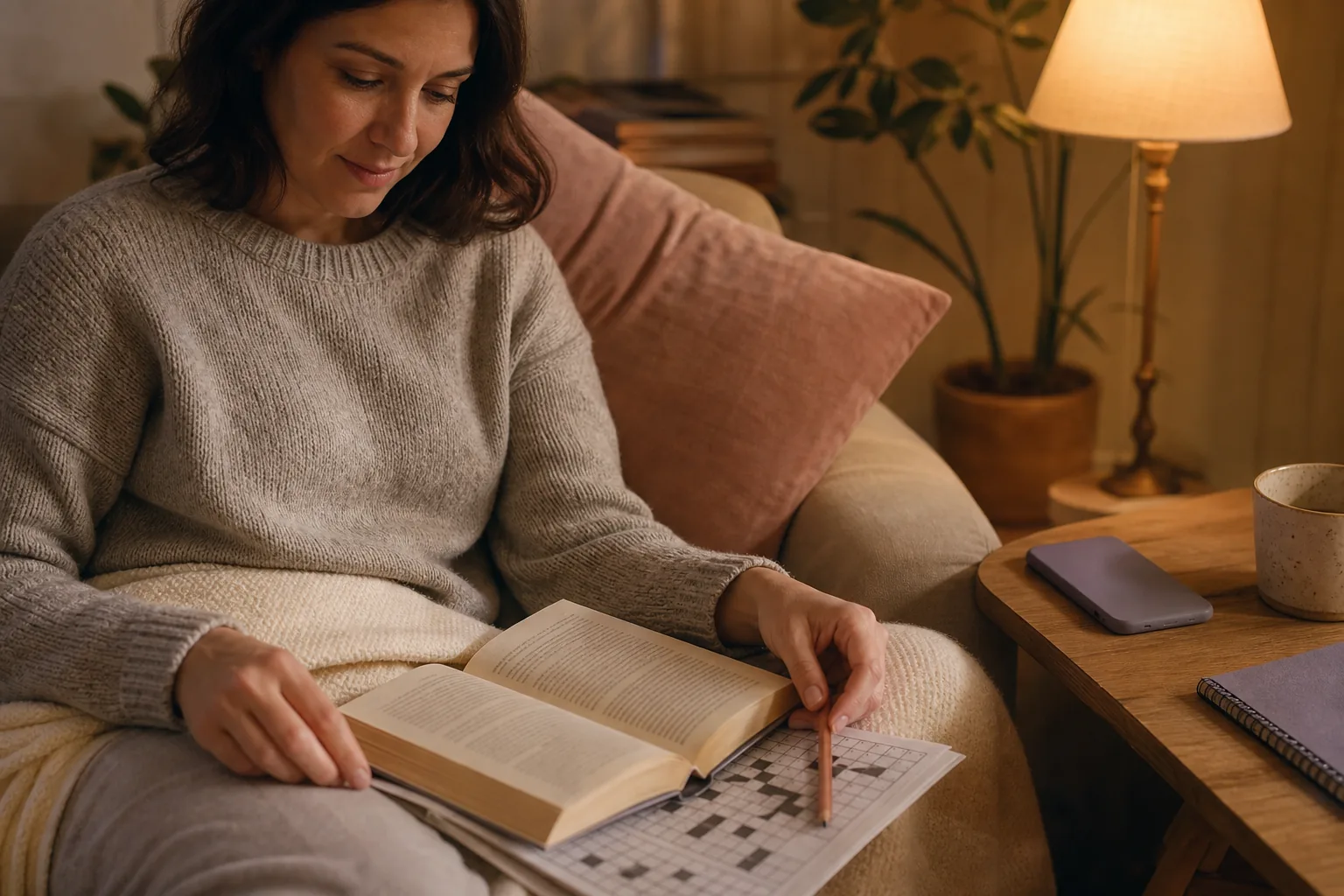
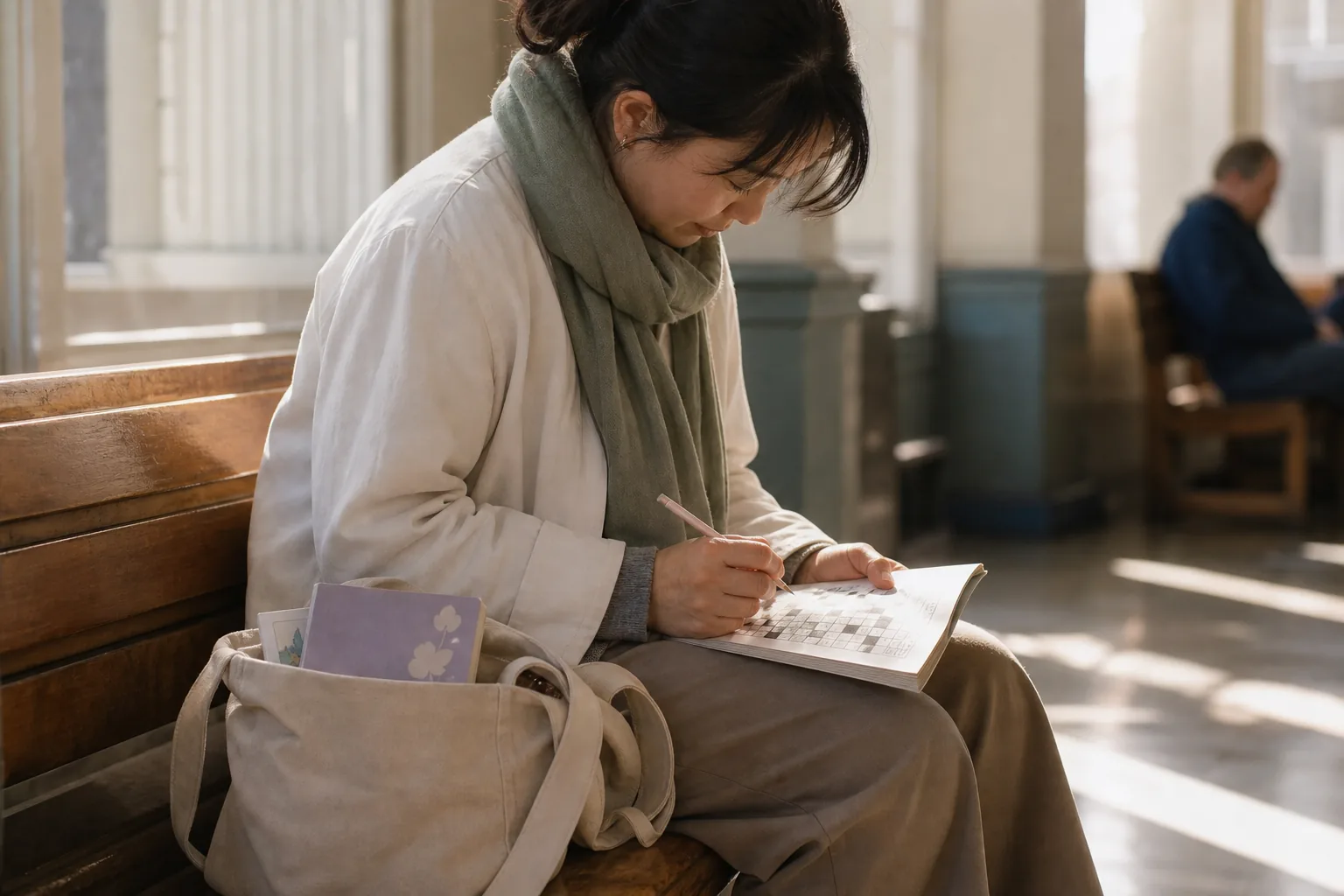
A bounded activity has a visible edge. You might read one short chapter, write a six-line scene, sketch the view from memory, fold one piece of paper, complete one page of a familiar activity, or make a list with a playful constraint. Try “five tiny things I would put in a museum” or “three questions I wish people asked more often.”
The activity should be easy to close without a ceremony. Avoid anything that spreads across several seats, makes a strong sound, leaves crumbs or scraps behind, or requires you to keep saying, “One second, I am almost finished.”
A satisfying stopping point is more useful than a grand plan. If the activity ends early, you can begin another small round or let the remaining minutes be open.
For a longer wait, choose depth without sprawl
A longer waiting-room stay can hold a deeper activity, especially when you are seated. The trick is to choose something that can absorb attention without taking over the space.
You might return to a familiar book, work on one repeatable section of a small hand project, draft a real letter, draw a map of a place you know well, or follow a self-contained set of paper instructions. Choose an activity whose next step remains visible after an interruption.
Before settling in, decide how you will stop. Mark the page. Finish the current row. Write one word that tells you what comes next. Fold the paper around the unfinished piece. A clear point of return lets the wait end when it ends.
For airports, hotel rooms, and trips where the waiting is part of a larger journey, the Analog Travel Reset Kit guide covers the separate question of travel preparation. This article stays with the waiting moment itself.
What is quiet enough for a waiting room?
Public spaces belong to more than one person. A waiting activity fits the room when it stays within your physical space, can stop quickly, and does not add avoidable sound, scent, flashing light, or mess.
Ask:
- Can I use this without spreading into the next seat?
- Will I hear my name or notice when the line moves?
- Can I put it away in a few seconds?
- Does it leave the space as I found it?
If the answer is no, save that activity for somewhere else. Curiosity can be portable without becoming the most noticeable thing in the room.
What can two people do together?
When someone is waiting with you, the time can become shared without turning into a formal game night.
You might:
- take turns finding an object that matches a chosen color;
- invent kind backstories for unusual objects in the room;
- ask one question that neither person has answered before;
- draw half of a picture and pass it over for the other person to finish;
- make a list together, such as five places you would revisit; or
- choose one small thing outside the window and describe it without naming it.
Keep the other person’s mood in the room. An invitation is enough. If they would rather be quiet, you can return to your own prompt without making the moment awkward.
Is looking around the room really an activity?
Yes. Observation does not need a product, a worksheet, or a finished result.
You may watch how the sunlight changes on a wall. You may notice the lettering on an old sign, the rhythm of arrivals and departures, or the care someone took in arranging a shelf. You may let your attention move without capturing any of it.
There is a quiet difference between noticing and documenting. You do not have to photograph the detail, look it up, or post it. It can remain a small thing you saw once.
That may be the most Whimsical Wanderer part of waiting: the world gets to be interesting before it becomes content.
Build a tiny waiting invitation
You do not need to carry a miniature craft room. Begin with one no-supply prompt and one bounded activity that fits the waits you actually encounter.
Write the prompt somewhere easy to remember: “Find the oddest useful detail.” Choose an activity you can begin and close without arranging a surface. Test both during one ordinary wait. If the activity stays buried, makes too much fuss, or does not hold your interest, replace it.
The Whimsical Wanderer Bag guide explores how curiosity can shape a fuller Analog Bag. If you are looking for alternatives across mornings, evenings, and home life too, continue with Things to Do Instead of Scrolling. For quieter days, Quiet Hobbies for Adults offers options organized by setup and available effort.
You can also take the Analog Self quiz if you are curious which pathway feels most familiar.
A small next step
Choose one no-supply prompt and one pocket-sized activity for your next wait.
When the line stops, notice what your hand reaches for. Then give it one other possibility.