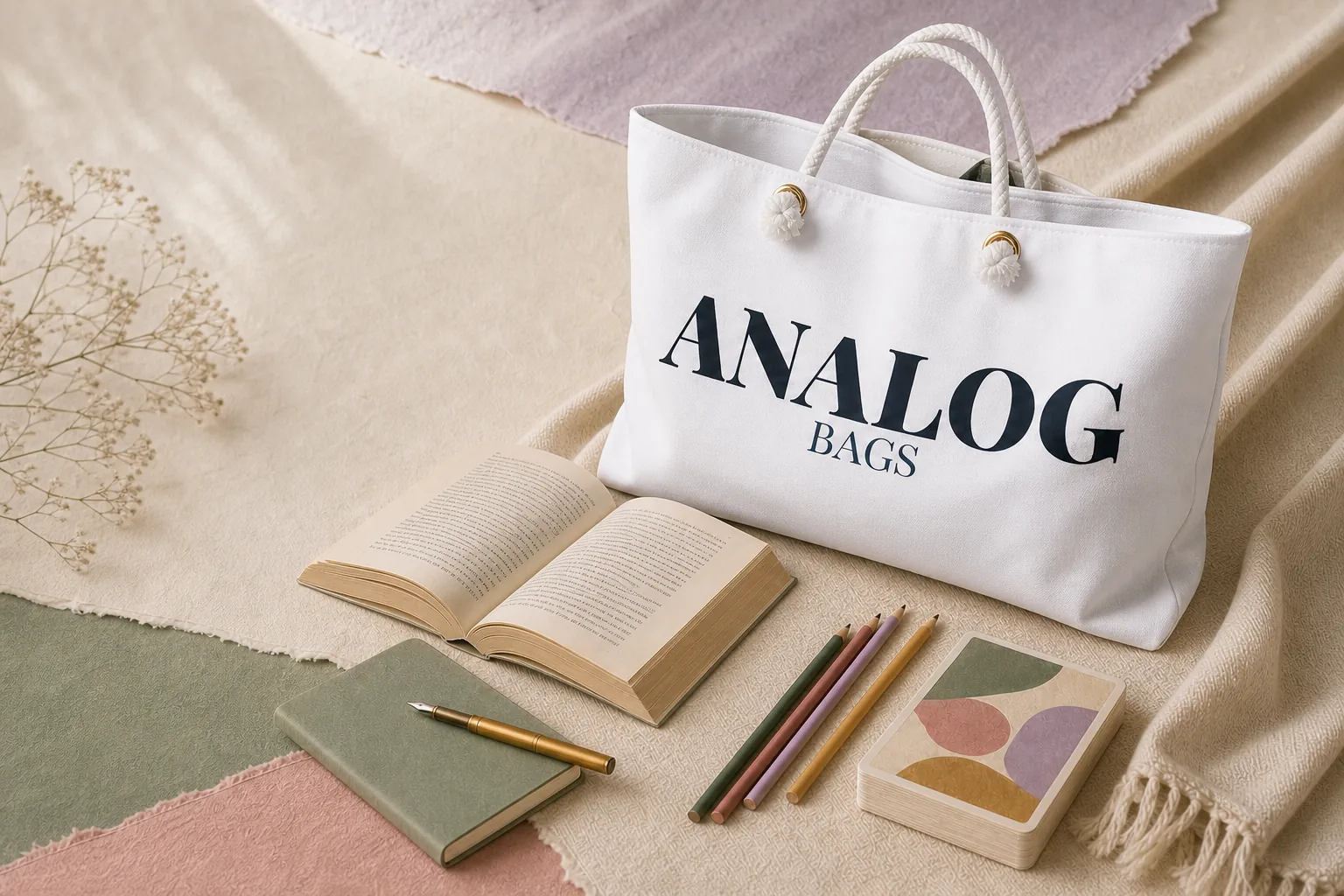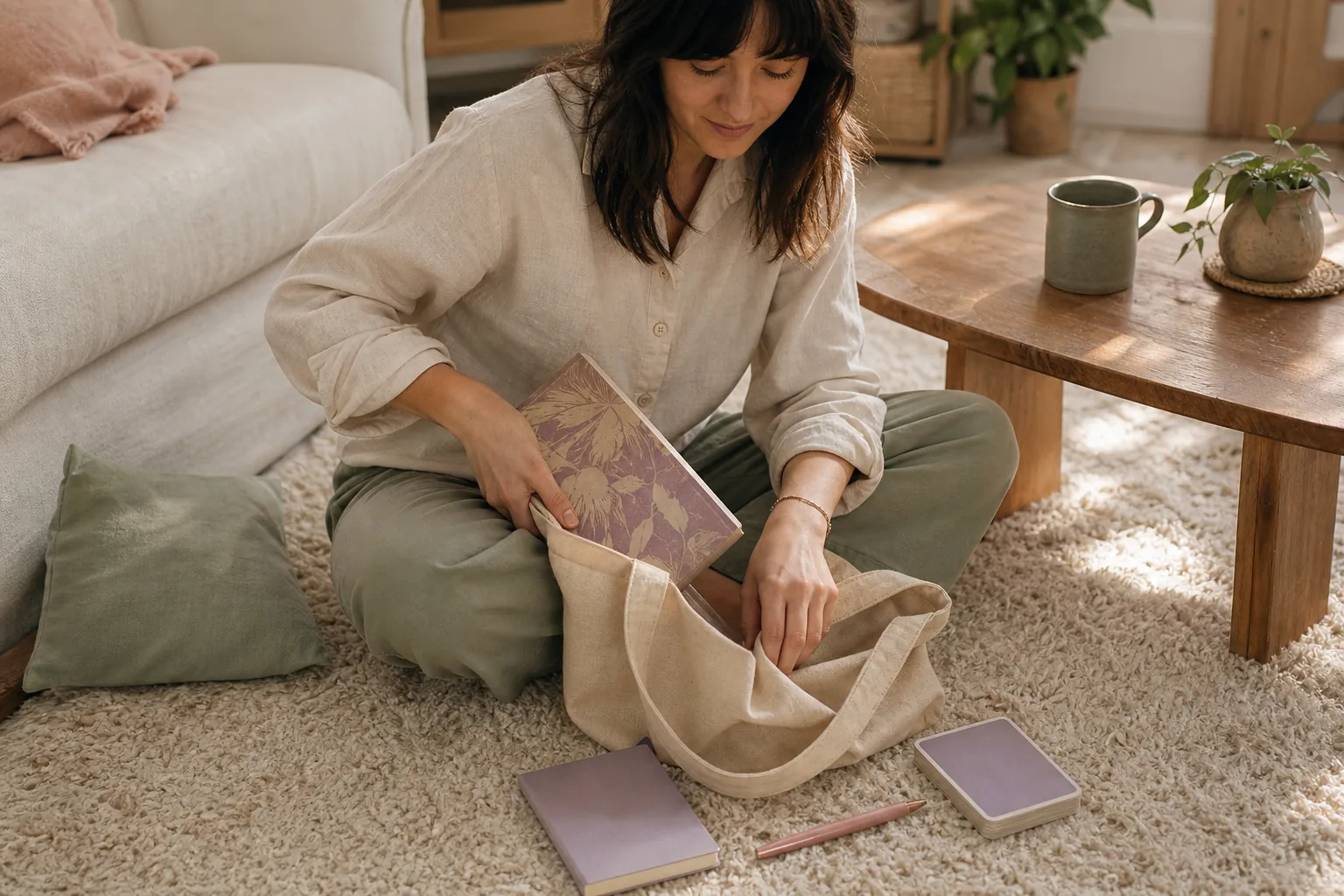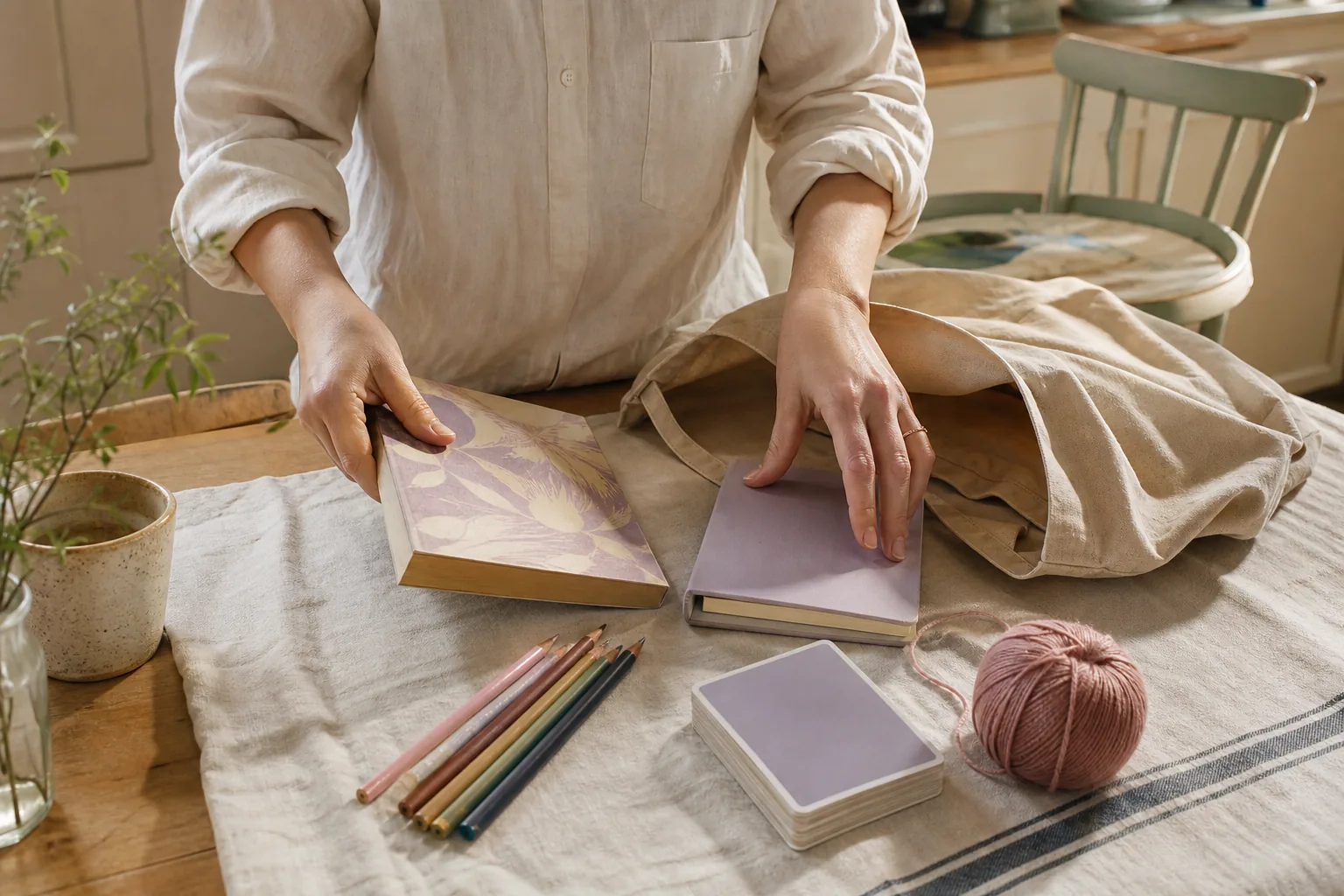
What can go inside an Analog Bag?
When you first meet the idea of an Analog Bag, a giant list of possibilities can create the exact problem you were trying to leave behind. Now there are fifty charming objects to compare, twelve new hobbies to research, and one more cart waiting for a decision.
Your bag does not need everything. It needs a small, understandable invitation.
For many adults, a useful first version has three kinds of contents:
- one main offline activity;
- one supporting piece that makes the activity easier or more comfortable; and
- one cue that helps you stop, reset, or return.
That could be a paperback, a bookmark, and a note marking your next page. It could be a few postcards, a pen, and an envelope for unfinished notes. It could be a small puzzle, a cloth pouch, and a card that reminds you where the loose piece belongs.
These are examples, not a required formula. The better way to choose is to begin with the moment you want to change.
This article is about the contents. The branded Analog Bag is a separate container available through the bags page, and it does not arrive filled. You can place your chosen contents in that bag or use a container you already own.
How much time do you usually have?
Time changes what feels inviting. An activity that is lovely for an open afternoon may feel ridiculous during a two-minute wait.
For two-minute openings
Choose something with no setup and no meaningful cleanup. You might:
- read one poem or one page;
- write down one question;
- study a postcard or small piece of art;
- make a tiny list;
- handle a familiar pocket object; or
- look closely at the light, shape, and movement around you.
The activity does not need to become a session. Two minutes can be the whole experience.
For ten-minute pauses
Choose something you can enter quickly and leave without losing your place. Possibilities include:
- a short paper puzzle;
- a few pages of a forgiving book;
- one card from a question deck;
- a small, repeatable hand activity;
- a note to someone you care about; or
- a bounded drawing, coloring, or pattern exercise.
A clear edge helps. One page, one card, one shape, or one short round can feel easier than “work on a hobby.”
For a longer pocket of time
You may want a story with room to open, a craft with several stages, a shared game, a letter, or a reflective practice. Longer does not have to mean more complicated. A familiar activity can become richer simply because nobody is rushing it.
If you have an hour, you do not have to fill the hour. You can stop when the invitation stops feeling inviting.
Where will you use it?
The same contents will not fit every setting. A good home bag may be roomy and soft. A public-space bag may need to be quiet, contained, and easy to carry.
At home
Home gives you more freedom in size and setup. A larger book, a flat paper activity, a tabletop game, or a small project can make sense when you have a surface and somewhere to leave it.
Still, reachability matters. If the bag lives behind a stack of boxes, its contents are more like storage than an invitation.
While waiting
Waiting asks for a smaller scale. Choose an activity that can stop when your name is called, the line moves, or the doors open. Paper prompts, observation games, pocket puzzles, and brief reading all fit naturally.
Keep sound and other people in mind. Something delightful at your own table may be distracting in a quiet room.
While traveling
Travel favors contents that are light, contained, replaceable, and easy to reach without opening every suitcase. Think about where the activity will be used, not only how neatly it fits.
The Analog Travel Reset Kit guide offers more specific packing ideas. Keep medication, identification, required documents, and emergency information separate and accessible. An Analog Bag is for attention and comfort, not safety-critical storage.
Outdoors
An outdoor bag can invite looking, sketching, reading, writing, or simple play. Choose materials that fit the weather and the place. Loose paper and a windy bench may not become friends, no matter how beautiful the notebook is.
In a shared space
Choose pieces that respect the room. Consider noise, scent, light, loose parts, and how much surface the activity takes. If another person may join, include an option that can be explained in one sentence.
How much effort is available?
An activity can be appealing in theory and still ask too much today.
Low-setup choices are already open, already sharpened, already sorted, or familiar enough that you do not need instructions. Medium-setup choices may need a table, a few pieces, or a short beginning routine. High-setup choices may need protective surfaces, careful cleanup, ventilation, heat, or several tools.
None of these categories is morally better. They simply belong in different moments.
When you are choosing contents, picture the first thirty seconds. Do you want to unzip one pouch and begin, or are you happy to arrange a small workspace? Does the activity still sound appealing when you imagine putting it away?
If the setup makes your shoulders rise toward your ears, that may be useful information.
What if you are not crafty?
An Analog Bag does not have to contain art supplies.
You might build around:
- reading;
- word or number puzzles;
- letter writing;
- observation;
- conversation;
- card or tabletop play;
- sorting and arranging;
- personal reflection; or
- simple rest with a familiar object nearby.
The six pathways are meant to widen your options. A Cozy Reader bag centers quiet reading. A Whimsical Wanderer bag follows curiosity. A Paper and Pen Purist bag makes room for lists, letters, and loose thoughts. Crafting is one doorway, not the whole house.
How do mess, noise, and portability shape the choice?
Before adding an item, ask a few ordinary questions:
- Does it leak, shed, stain, roll away, or dry out?
- Does it make a sound that fits the setting?
- Does it have small, sharp, hot, scented, or fragile parts?
- Does it need a table, outlet, sink, or special light?
- Can it be paused without losing the work?
- Can the bag close when the item is inside?
These questions are not meant to make every choice bland. They help the playful thing arrive in a place where it can actually be used.
A soft-glide pencil may belong in a cafe bag. A project with heat, fumes, or complicated cleanup probably belongs somewhere more controlled. A scented object may delight one person and bother another. Personal preference and the real setting win.
The How We Choose page explains the broader selection approach used across Analog Bags.
Will the moment be solo or shared?
Some activities become quieter when done alone. Others come alive when passed across a table.
For a solo bag, choose something that makes sense without instruction or an audience. For a shared bag, choose a clear beginning and a comfortable way to opt out. A conversation card, collaborative puzzle, simple game, or shared page can work when the other person genuinely wants to join.
You can also include one of each. The bag might hold a solo option for a waiting room and a shared option for a weekend table.
Sharing should remain an invitation. No one has to answer a personal question, perform creativity, or stay with an activity longer than they want.
Can you mix the six pathways?
Yes. The pathways describe different kinds of offline invitations, not six sealed boxes.
You might combine:
- a Cozy Reader story with a Paper and Pen note page;
- a Diamond Artist making activity with a Whimsical Wanderer question;
- a Mindful Mystic reflection cue with a familiar Gentle Soul texture; or
- a Gentle Soul quieter option with whatever activity currently asks the least of you.
Mixing works best when the pieces belong to the same moment. A bag does not become more personal merely because it contains more categories.
If you are unsure where to begin, the Analog Self quiz can offer a first pathway. You can borrow from the others whenever something resonates.
Does a Kindle count?
A Kindle or other e-reader is digital, so it is not analog in the literal sense. If your goal is reading instead of returning to a feed, decide whether a single-purpose device fits your boundary. The article on how to start reading again explores that choice more fully.
You get to decide whether a screen-light tool fits your version. Name it honestly. There is no prize for purity.
How many items are enough?
Enough means the choice is visible without becoming crowded.
For a small bag, one main activity and one supporting piece may be plenty. A home basket may hold several options if each one is easy to see and return. If you have to unpack five things before reaching the one you want, the bag may be carrying decisions rather than easing them.
Begin smaller than your imagination wants to. Use the bag once. Add something only when you can name the missing function.
What may be better left out?
Leave out anything that:
- requires more setup than you are willing to give;
- feels irritating, confusing, or burdensome to the person using it;
- does not fit the safety needs of the user or setting;
- creates cleanup that will keep the bag from being opened;
- exists only because it looked correct in someone else's bag; or
- turns a gentle pause into a performance.
An unfinished item is not a failure. It may simply belong somewhere else.
A gentle next step
Choose one main activity and one supporting piece for a real moment in your week. Then browse what can go inside only for what is genuinely missing. If you are ready to assemble the first version, follow the simple building process.