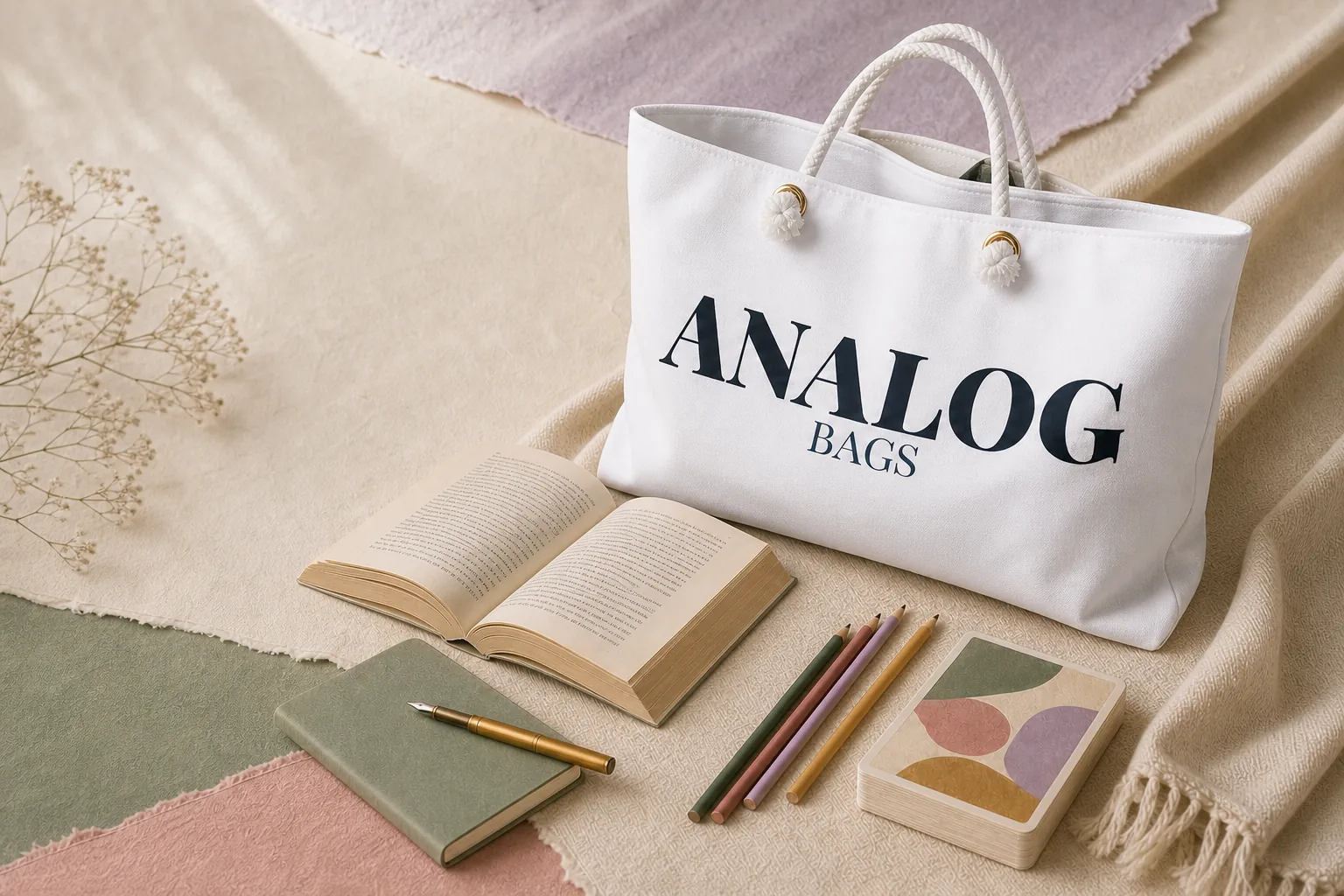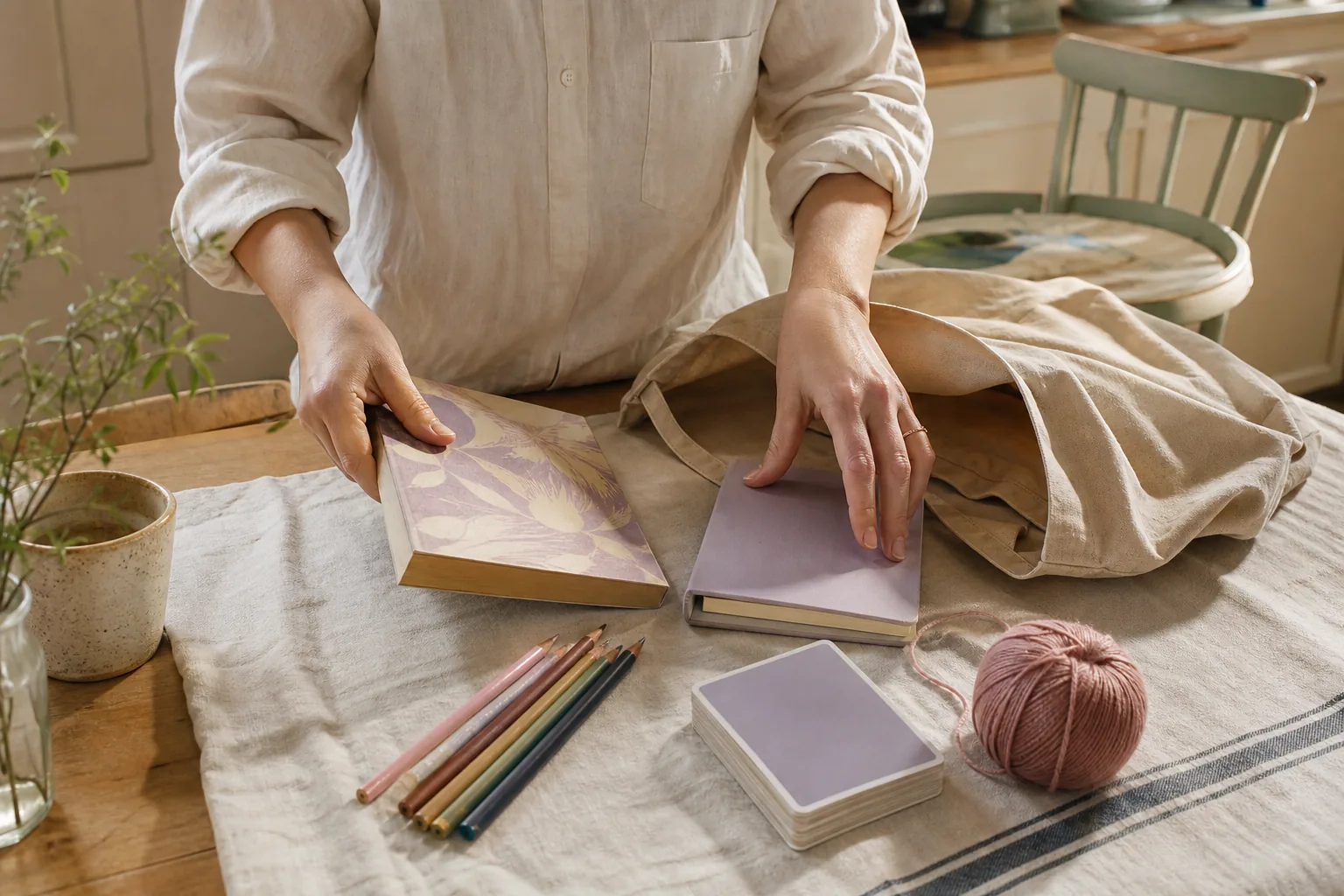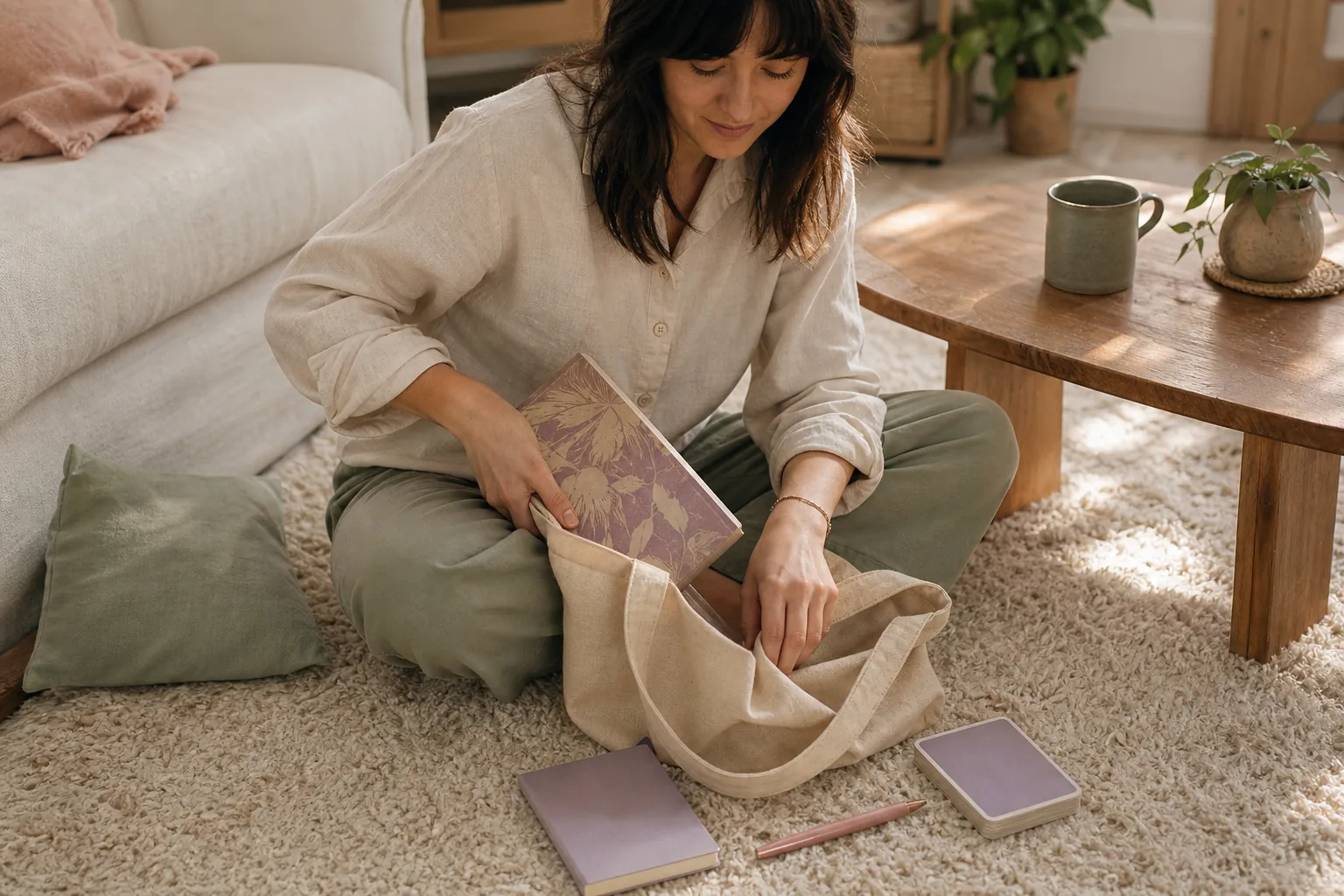
Begin with an imperfect version
When you like the idea of an Analog Bag, it is easy to turn the beginning into a research project. You compare containers, save lists, imagine six possible hobbies, and wait for the version that looks complete.
The bag does not have to be complete. It has to be usable.
You can build your own Analog Bag with a container, one main offline activity, one supporting object, and a simple cue for closing or returning. Most first versions can begin with things already in your home.
This article owns the building process. If you are still deciding what the category means, start with What Is an Analog Bag?. If you want to compare possible contents, explore Analog Bag ideas for adults.
1. Which moment do you want the bag to serve?
Do not begin with products. Begin with a scene.
Picture one ordinary moment when you would like another choice. Maybe it is ten minutes after work, a quiet hour before bed, a wait in the car, a weekend morning, or the space after dinner when your hand keeps finding the phone.
Name the moment in one plain sentence:
- I want something quiet to do after I close my laptop.
- I want one portable option for waiting.
- I want a way to make things at the kitchen table without opening a whole closet.
- I want a small invitation to write when my thoughts feel tangled.
The sentence gives the bag a job. It also helps you say no to lovely objects that do not serve that job.
One bag does not need to solve every offline moment. You can build for the life directly in front of you.
2. Choose a container that is easy to reach
The first container can be a tote, pouch, basket, box, or backpack you already own. It should fit the activity, open without a struggle, and live where the chosen moment actually happens.
If your bag is for the couch, a soft basket beside the chair may work. If it is for waiting, a small pouch inside your everyday bag may be easier. If it is for a shared table, a handled box may move from shelf to surface in one trip.
Before choosing by appearance, try the ordinary motions:
- Can you lift it comfortably?
- Can you see or reach the main activity?
- Can you close it without forcing the contents?
- Can you return it to its place in less than a minute?
A dedicated branded container may feel useful when you want the ritual to have a clear identity, need a different size, or want a bag designed to be carried. The branded Analog Bags page is for the container only. Books, activities, tools, and other contents are chosen separately.
3. Choose one main offline activity
The main activity is the reason to open the bag. Choose the thing you are most likely to use in the moment you named.
It might be reading, writing, drawing, coloring, puzzling, arranging, making, reflecting, observing, or playing something with another person. Choose a familiar activity if learning a new one would add too much friction.
Try to make the activity specific enough to picture. “Be creative” is wide and slippery. “Color one postcard” has an edge. “Journal” may feel heavy. “Write one ordinary page” may feel possible.
You are not choosing a new identity. You are choosing one invitation.
If you want pathway-specific shopping detail, the guide library holds complete bag guides. Keep that detail there. Your version zero only needs one main activity.
4. Add one supporting object
A supporting object makes the main activity easier to begin or more comfortable to use. It should solve one practical friction point.
For example:
- a bookmark keeps a reading return visible;
- a pencil pouch keeps the needed tools together;
- a firm envelope protects a loose paper activity;
- a washable cloth gives a small making project a clear surface; or
- a familiar object makes the place feel more intentional.
Choose one. If you add five supporting pieces before the first use, you may be building a display instead of a doorway.
A supporting object does not need to promise a change in mood or health. Its job can stay practical: hold the page, contain the pieces, soften the light, lower the mess, or make the beginning easier to see.
5. Add a clear closing cue
An activity is easier to reopen when it has a simple ending.
Your closing cue might be:
- a bookmark placed at the next page;
- a small envelope for loose pieces;
- a folder for unfinished paper;
- a card that says where the project stopped;
- a photograph of a temporary arrangement; or
- an empty pocket that reminds you to return the tool before closing the bag.
The cue does not need to be inspirational. It needs to help the next version of you understand what to do.
Closing is part of the invitation. When the pieces have an obvious home, tomorrow's beginning asks less.
6. Test the bag for five minutes
Use the bag before you improve it.
Place it where the chosen moment happens. Open it. Begin the main activity. After about five minutes, you can stop and notice what happened.
Ask:
- Was the bag easy to reach?
- Could I begin without looking for something else?
- Did the activity fit the time and setting?
- Was anything noisy, irritating, awkward, or messy?
- Could I stop and put it away easily?
- Would I want to open this version again?
This is not a test of your discipline. It is a test of the arrangement.
If you did not use the bag at all, the answer may not be “try harder.” The container may be hidden. The activity may ask too much. The moment may be wrong. Move one piece and try again.
7. Remove what creates friction
Editing the bag is as important as filling it.
Remove anything that:
- catches, leaks, sheds, or rolls loose;
- requires a missing tool;
- takes longer to set up than the moment allows;
- adds a scent, sound, texture, or light you do not want;
- makes cleanup feel larger than the activity; or
- stays in the bag only because it looks like it belongs.
You do not need to make an item work. Put it somewhere more appropriate, offer it to someone who wants it, or return it according to the seller's policy.
The goal is not a full bag. The goal is a clear invitation.
8. Give the bag a visible home
Where the bag lives matters more than how carefully it is labeled.
Place it near the recurring moment you chose. A reading bag might sit beside the chair where evening scrolling begins. A writing pouch might live near the kitchen table. A waiting kit might stay inside the everyday bag, not in a closet at home.
Keep essential items separate. An Analog Bag is not the place to bury medication, identification, keys, emergency information, or required travel documents beneath a project.
If other people share the space, choose a location that is visible without becoming an obstacle. The bag should be easy to notice and easy to put away.
9. Rotate only when the invitation goes quiet
Novelty can be fun, but constant rotation creates another maintenance system.
Keep the first version long enough to learn whether it fits. Change it when:
- the activity no longer interests you;
- the season or setting changes;
- the contents no longer fit the available time;
- a piece is used up, broken, or irritating; or
- you can name a different invitation you want the bag to offer.
You do not need a schedule. You do not need themed monthly refills. Let actual use tell you when the bag wants an edit.
How much should an Analog Bag cost?
There is no required spend.
A version made from a tote, paperback, bookmark, and note card already at home may cost nothing. If something is missing, decide what function is missing before shopping. “I need a pen that does not smear on this paper” is clearer than “I should upgrade the whole writing bag.”
Browse the shop for possible contents only after separating what you own from what you genuinely need. If you want a dedicated branded container, visit the bags page separately. The container and contents are not sold as one filled purchase.
Should the bag stay home or travel?
Let the chosen moment decide.
A home bag can be larger and may rely on a table, lamp, or nearby shelf. A travel bag should be easier to carry, quieter in shared spaces, and simple to pause. If the same activity belongs in both places, you may prefer a small pouch that moves between a home container and an everyday bag.
Do not force one bag to perform every job. A stable home bag and a tiny waiting pouch can be simpler than one overfilled solution.
A gentle next step
Build a version zero with three familiar objects inside a container you already own: one main activity, one supporting piece, and one closing cue. Use it once before buying anything. For another soft starting point, visit the Screen-Free Self-Care Starter Bag guide.